Romance
This entry follows the Romance and later storytelling. The Records do not contain it, or keep only a faint parallel.
Late Han · Three Kingdoms · Jin unification
A reading desk for the Romance of the Three Kingdoms and Chen Shou’s Records. Each entry is marked as fiction, history, or both.
Try “Liu Bei”, “Red Cliffs”, or 空城计. Filtering happens in the browser.
No matching entries.
This entry follows the Romance and later storytelling. The Records do not contain it, or keep only a faint parallel.
Drawn from the Records of the Three Kingdoms and Pei Songzhi’s notes. Famous novel scenes are not stated as fact.
The frame is historical. Character, dialogue, and scale are often rewritten by the novel.
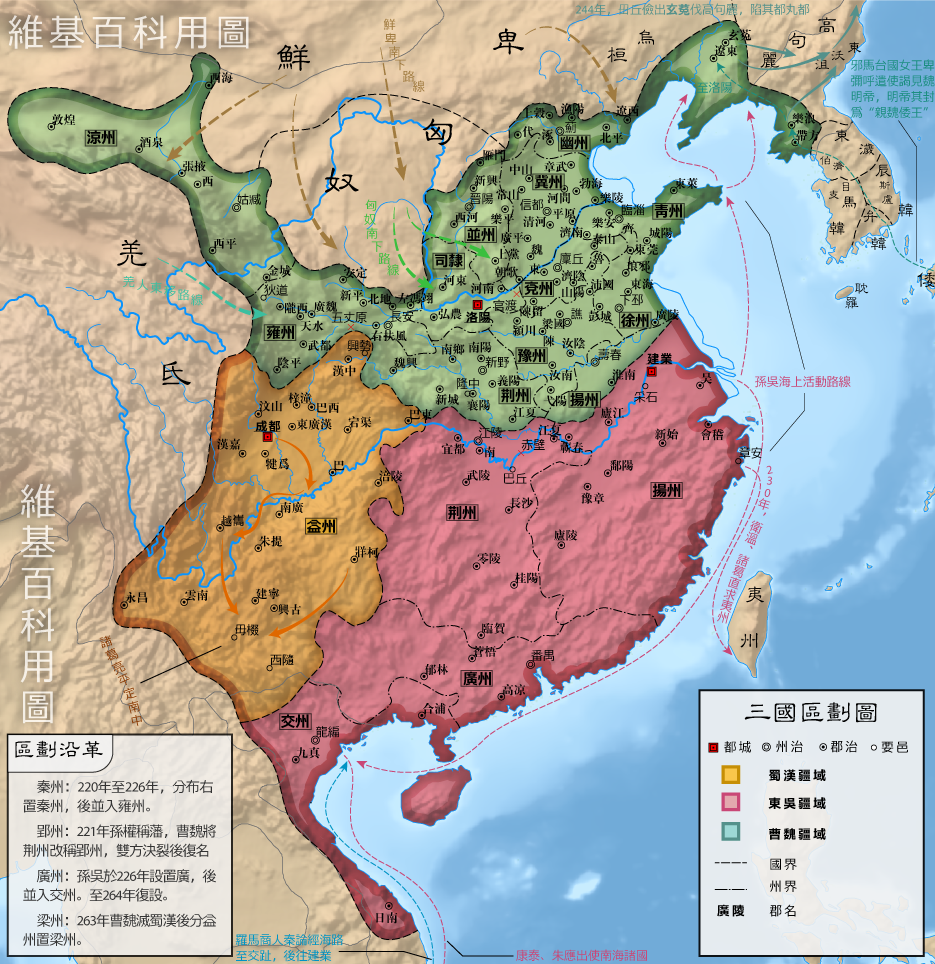
An overview of administrative divisions in the middle and late Three Kingdoms, not a precise battle map. Markers open place entries.
Map by 玖巧仔, 2011. Wikimedia Commons. License: CC BY-SA 3.0. Shown unmodified.
Founding emperor of Shu Han. He claimed imperial Han kinship, gathered Guan Yu and Zhang Fei, took Jing and Yi with Zhuge Liang’s counsel, and died at Baidi after the defeat at Yiling.
Shu HanBothChancellor of Shu Han. The Longzhong plan, the regency, the southern campaign, and the northern expeditions are historical. The empty fort, the borrowed arrows, and the east wind are the novel.
Cao WeiBothThe effective ruler at the end of the Han and the founder of Cao Wei’s power. He held the emperor at Xu, broke Yuan Shao at Guandu, and lost at Red Cliffs. He never took the imperial title. The novel’s villain is not Chen Shou’s verdict.
Eastern WuBothFounder of Eastern Wu. He inherited Jiangdong at eighteen, chose to resist at Red Cliffs, took Jing province, and became emperor in 229. His long reign ended less open than it began.
Cao Cao held Guandu with the smaller force, then burned Yuan Shao’s supplies at Wuchao. The battle decided the north. The frame is the Records, not a plot invented by the novel.
Winter of Jian’an 13 (208)BothAfter taking Jing province, Cao Cao met Sun Quan and Liu Bei. Huang Gai’s fire attack is historical. The beating, the stolen letter, the borrowed arrows, and the east wind are the novel’s additions to the same battle.
Zhangwu 2 (222)BothLiu Bei’s eastern campaign after he became emperor. Lu Xun waited, then used fire. The fire and the rout are historical. Seven hundred li of camps, and Zhuge Liang foreseeing it from Chengdu, are the novel’s scale.
263RecordsThe path by which Shu actually fell. Zhong Hui could not break Jiang Wei at Jian’ge. Deng Ai came through the Yinping paths onto the Chengdu plain.
Twelve people, from Liu Bei to Dong Zhuo.
101Shu, Wei, Wu, and the contenders.
4Luoyang, Chengdu, Jianye, and the fields.
19Guandu, Red Cliffs, Yiling, and others.
14Empty fort, chain plot, borrowed arrows.
12From 184 to 280.
42Novel, history, screen, and games.
12Zhongping 1 (184)
Records Zhang Jue rose through the Way of Great Peace. The Han’s hold on the provinces loosened. Liu Bei and Cao Cao began as men who fought the Turbans.
Winter of 208
Both The Sun–Liu alliance burned Cao Cao’s fleet at Red Cliffs. The three-way division begins. The fire is history. Many of the schemes are the novel.
Zhangwu 2 (222)
Both Lu Xun burns Liu Bei’s camps and Shu breaks. The year before, Cao Pi had already made Sun Quan King of Wu.
Jianxing 12 (234)
Both Zhuge Liang dies in camp at Wuzhangyuan and the Shu army withdraws in order. The saying that a dead Zhuge routed Sima Yi is in Pei’s notes. The empty fort is not this campaign.
Taikang 1 (280)
Records Wang Jun’s tower ships come down from Yi. Du Yu and Wang Hun advance on other roads. Sun Hao surrenders in Jianye. The last of the three states ends.